How to Get the Best Deal on a Reconditioned Range Rover Engine for Sale in the UK with Supply and Fit
7 min read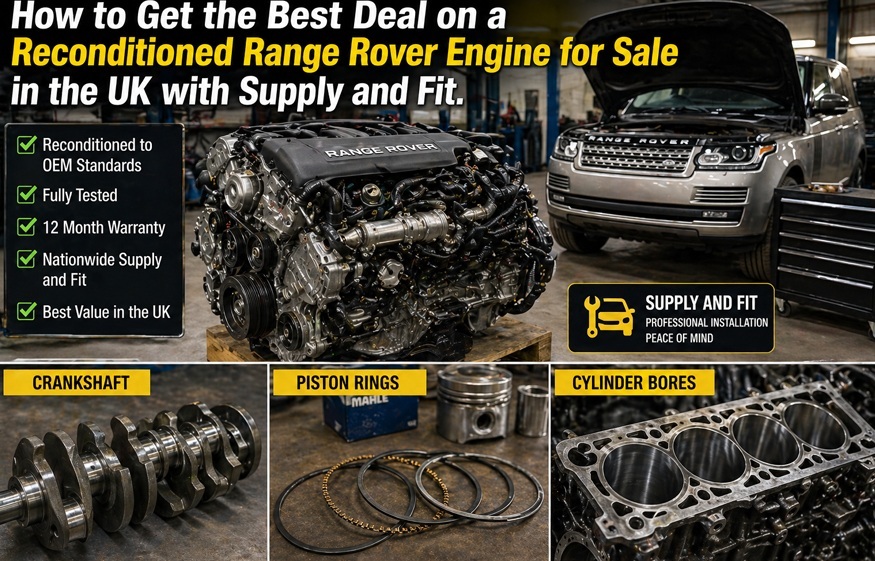
What Is a Reconditioned Range Rover Engine and How Does It Differ from a Rebuilt or Remanufactured Engine?
When your Range Rover starts showing the tell-tale signs of serious mechanical wear — excessive oil consumption, loss of compression, or a persistent knocking from the engine bay — you’ll quickly find yourself wading through a range of terminology that can feel confusing. A reconditioned engine is one that has been stripped down, inspected, and restored to meet manufacturer tolerances and clearances, with worn or damaged components replaced using OEM (Original Equipment Manufacturer) parts where possible. The process typically involves cylinder head resurfacing, crankshaft grinding, engine block honing, and the fitment of oversized pistons and rings to restore proper compression. British Engineering Standards (BS EN) often guide the quality benchmarks for this type of work, giving buyers a degree of confidence in the integrity of the finished unit. The result is a powerplant that performs reliably without the cost of a brand new assembly.
Where things get a little more nuanced is in distinguishing this from a rebuilt engine or a remanufactured engine. A rebuilt unit tends to refer to a more selective restoration — components are replaced only where visibly worn or damaged, without necessarily returning every measurement to factory-fresh specification. A remanufactured engine, by contrast, is typically the most thorough process of all, involving complete disassembly, full machining, and reassembly to OEM standards on an industrial scale, often carried out by specialist facilities rather than local workshops. A recon engine (short for reconditioned) is a term used widely across the UK and sits broadly in the same category as reconditioned, though the depth of work can vary between suppliers. Understanding these distinctions matters enormously when you’re comparing reconditioned engine prices or deciding which type of replacement engine best suits your budget and reliability expectations.
How Much Does a Reconditioned Range Rover Engine Cost in the UK, and What Affects the Price?
One of the first questions any owner asks when facing a major engine failure is how much the whole thing is going to cost. The honest answer is that reconditioned engine prices vary considerably depending on the engine variant, the extent of the machining work involved, whether VAT is included, and what warranty is offered with the unit. A basic recon engine for an older TD5 or 3.0 TDV6 Land Rover unit might start from around £1,200 to £2,000 plus fitting, while a more complex supercharged petrol unit could push well beyond £3,500. Many suppliers now offer published reconditioned engines price lists or fixed-price quotes on their websites, which makes initial comparison much easier — though you should always confirm whether the stated engine price is VAT inclusive and whether it covers a surcharge exchange policy, where you’re expected to return your old core unit as part of the deal.
Read More: Helmer and the Evolution of Opening Systems: Convenience and Innovation for the Future
Several other factors shape the final cost of reconditioned engine work. Labour rates per hour differ significantly between a main dealer, an independent VAT-registered garage, and a mobile mechanic — and the fitting process for a Range Rover is not a quick job, often requiring ECU re-programming, a full fluid flush and refill (coolant and oil), and the replacement of ancillary parts such as the water pump and timing belt while access is available. Market value depreciation of your vehicle is also worth factoring in: it rarely makes financial sense to invest heavily in a high-mileage body that won’t recover its value post-repair. A reliable supplier should offer transparent pricing, a clear warranty claim procedure, and buyer protection guarantees so you know exactly what you’re committing to before any work begins.
Where Can You Buy a Quality Used or Second Hand Range Rover Engine for Sale in the UK?
Finding a trustworthy source for a used engine for sale in the UK takes a little more research than a quick internet search, but the effort is absolutely worth it. The UK has a well-established market for second hand engines, with suppliers ranging from large national breakers and engine remanufacturing specialists to smaller independent garages and online platforms. When searching for a 2nd hand engine or a low-mileage petrol or diesel unit, you’ll want to prioritise suppliers who can provide verified mileage documentation, service history records, and information about the condition of the donor vehicle — ideally with an HPI clearance check to confirm the source wasn’t a written-off or stolen vehicle. Customer testimonials and Trustpilot ratings are genuinely useful here, as they reflect real-world experience with after-sales support and delivery reliability. Secure checkout and escrow services offered by some platforms add an additional layer of protection for higher-value purchases.
The question of where to buy engines often comes down to convenience and confidence. Local searches for engine sales near me or refurbished engines near me can turn up excellent independent specialists with strong regional reputations, while national suppliers may offer a broader stock of reconditioned engines UK units with faster despatch. Online engine marketplaces have improved dramatically in terms of product listings and buyer protection, but always verify that the seller can provide a written guarantee and that the unit has been tested before despatch. Whether you’re looking to find engine for my car through a specialist broker or approaching a known breaker directly, the golden rule is the same: never buy without documentation, never skip the warranty conversation, and never assume that a low advertised engine for sale price automatically reflects good value without checking what’s actually included.
What Should You Look for When Choosing an Engine Supply and Fit Service Near You?
Opting for an engine supply and fitting service — where you pay one supplier to both source the unit and carry out the installation — is often the most practical route for Range Rover owners who don’t want the headache of coordinating separate purchases and garage bookings. The convenience is real, but so is the need for careful vetting. A good engine supply and fit near me provider should employ fully certified technicians with documented experience on Land Rover and Range Rover platforms specifically. These vehicles have increasingly complex electronics, and a unit swap without proper attention to diagnostic trouble codes (DTCs) or ECU re-programming can result in persistent warning lights, limp mode, or compromised performance even after a mechanically sound installation. Ask upfront whether the price includes a full diagnostic scan before and after fitting, and whether the technicians have access to an engine hoist and the specialised tools the job demands.
Beyond the technical credentials, the best replacement engine supplier near me services will also include all the small but important extras that inexperienced garages sometimes overlook: a complete fluid flush and refill, the replacement of the thermostat, water pump, and timing belt as part of the service, and a final compression testing check before the vehicle is returned to you. VOSA approved garages will typically meet higher baseline standards for both safety and quality of workmanship. It’s also worth asking about a recovery service in case of unexpected issues post-fitting, as a reputable supplier should stand behind their work. Engine supplied and fitted packages that bundle parts and labour into a single fixed quote are increasingly common and can offer genuine savings over managing the two elements separately — just read the terms carefully to understand exactly what’s guaranteed and for how long.
How Do You Compare Reconditioned, Used, and New Engines to Find the Best Value for Your Range Rover?
The decision between a used engine, a reconditioned unit, and a new replacement engine is rarely straightforward, and it’s one that deserves a clear-headed comparison rather than a snap decision based on the cheapest headline price. A used motor engine sourced from a low-mileage donor vehicle can represent excellent short-term value — particularly if the donor car was well maintained and the mileage is independently verified — but it comes with inherent uncertainty about the internal condition of components like the crankshaft, piston rings, and cylinder bores.
There’s no guarantee of how those parts were treated before the engine was removed, and a unit that looks clean externally can still have underlying wear that only shows under load. This is where reconditioned and remanufactured units have a clear advantage: the internal combustion assembly has been inspected, measured, and restored to defined tolerances, giving you a known quantity rather than an unknown one.
What Are the Most Important Questions to Ask Before Committing to an Engine Replacement in the UK?
Before you authorise any work on a Range Rover engine replacement, there are several practical questions that every owner should be asking — and if a supplier is reluctant to answer any of them clearly, that itself tells you something important. Start with the warranty: not just its duration, but exactly what it covers. Does it include parts and labour? Is it honoured across the UK or only at a specific garage?
Read More: Classic and Luxury Car Shipping: Why Enclosed Transport Is Worth It
What is the formal warranty claim procedure, and how quickly can you expect a resolution if a fault develops? A supplier confident in the quality of their reconditioned engines will have clear, written answers to all of these questions. Also ask about the specific machining work that has been carried out on the unit — oversized pistons and rings, crankshaft grinding, engine block honing — and whether you can see any documentation confirming the rebuild specification and the tolerances achieved.